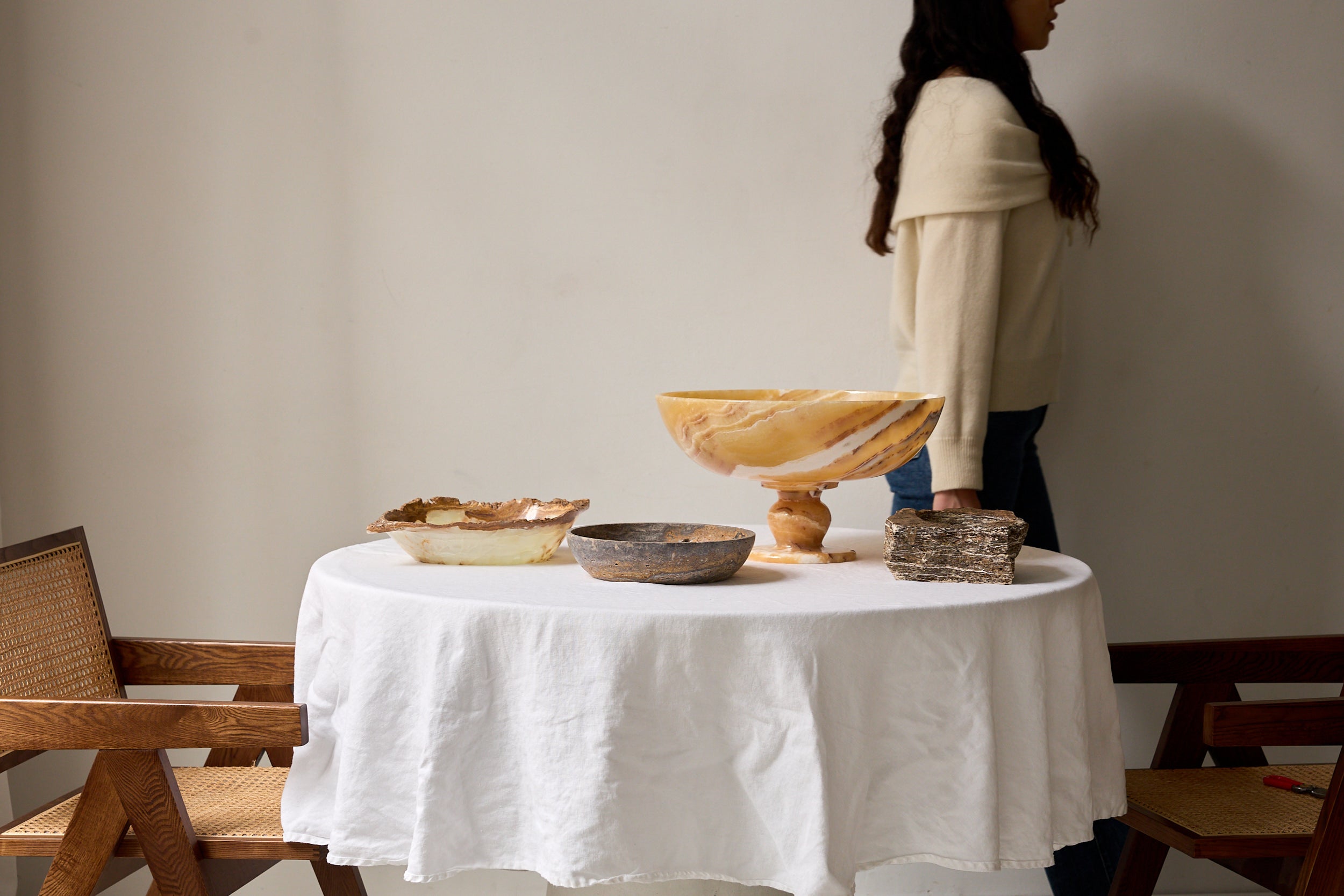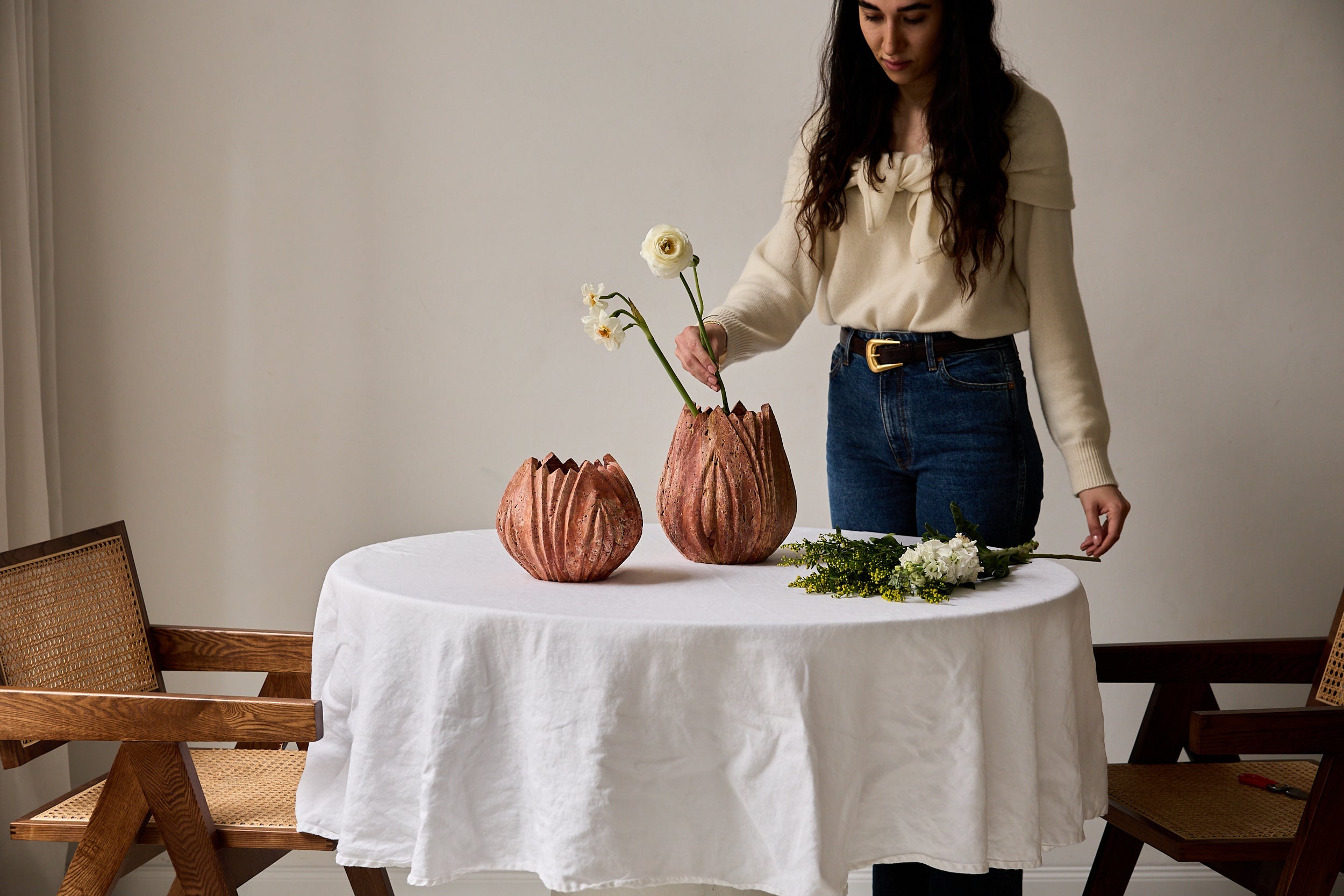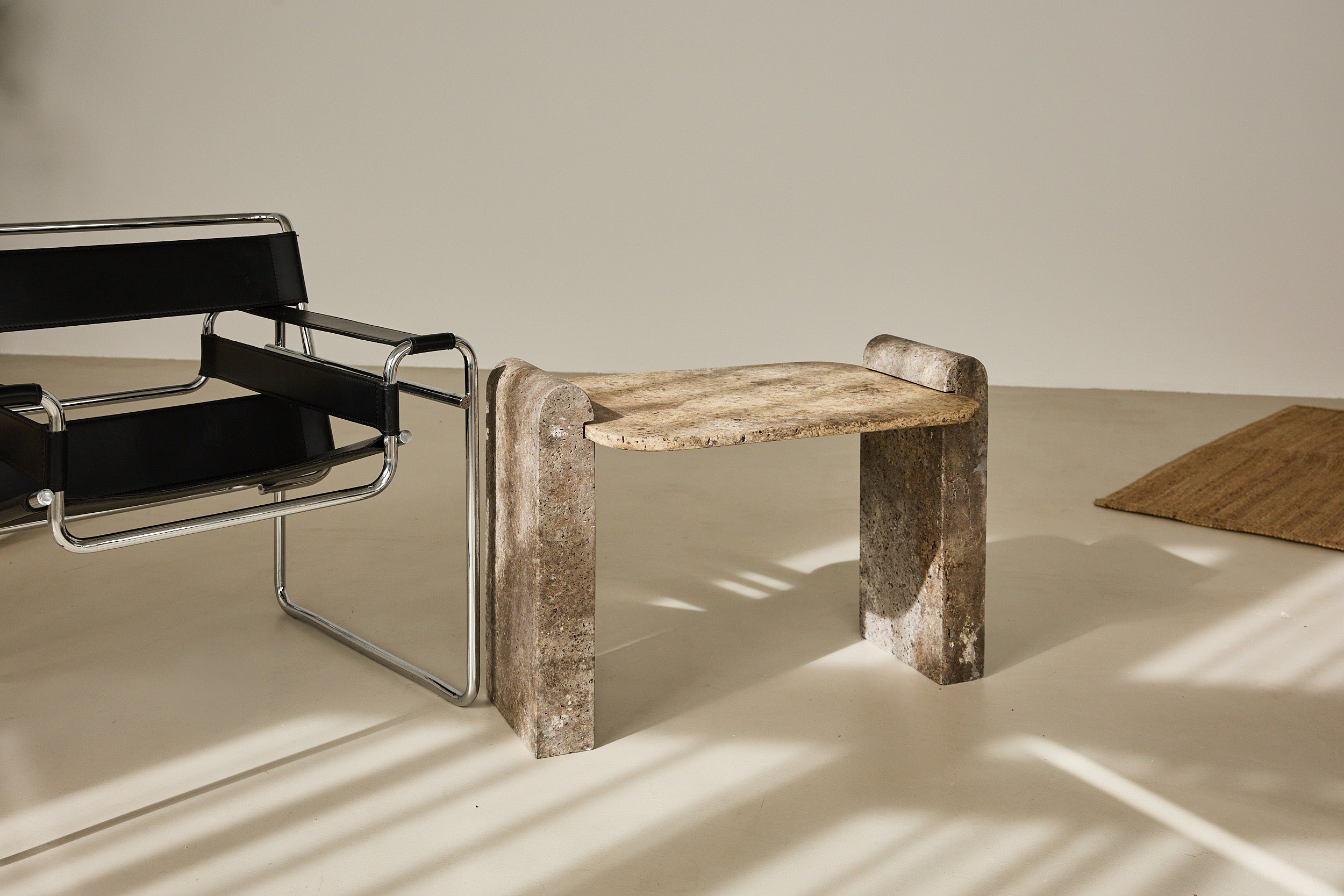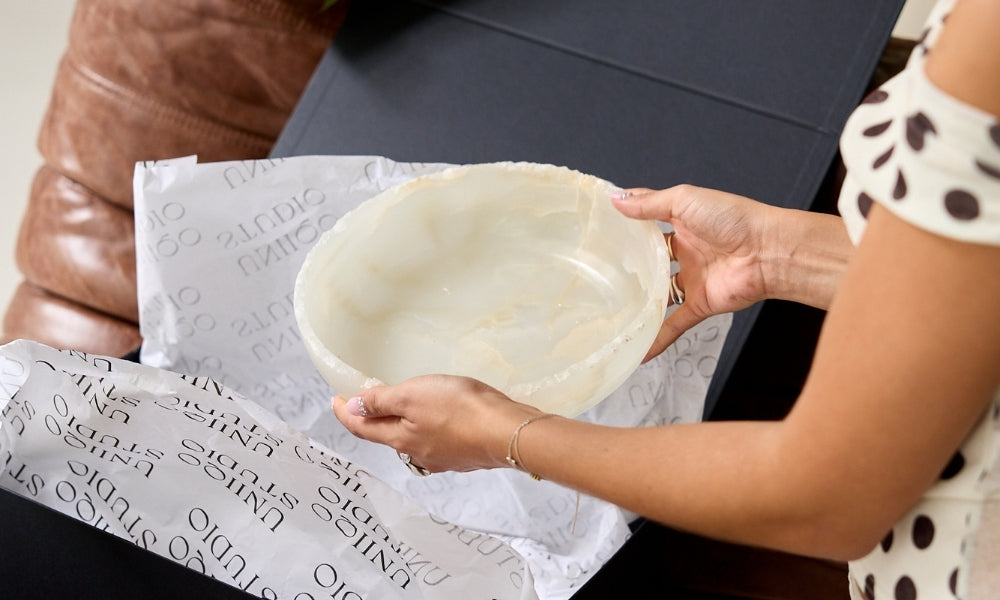
Three stones. Three different relationships with the world. These guides cover everything you need to keep your piece looking exactly as it should, or better, over time.

Onyx Care Guide
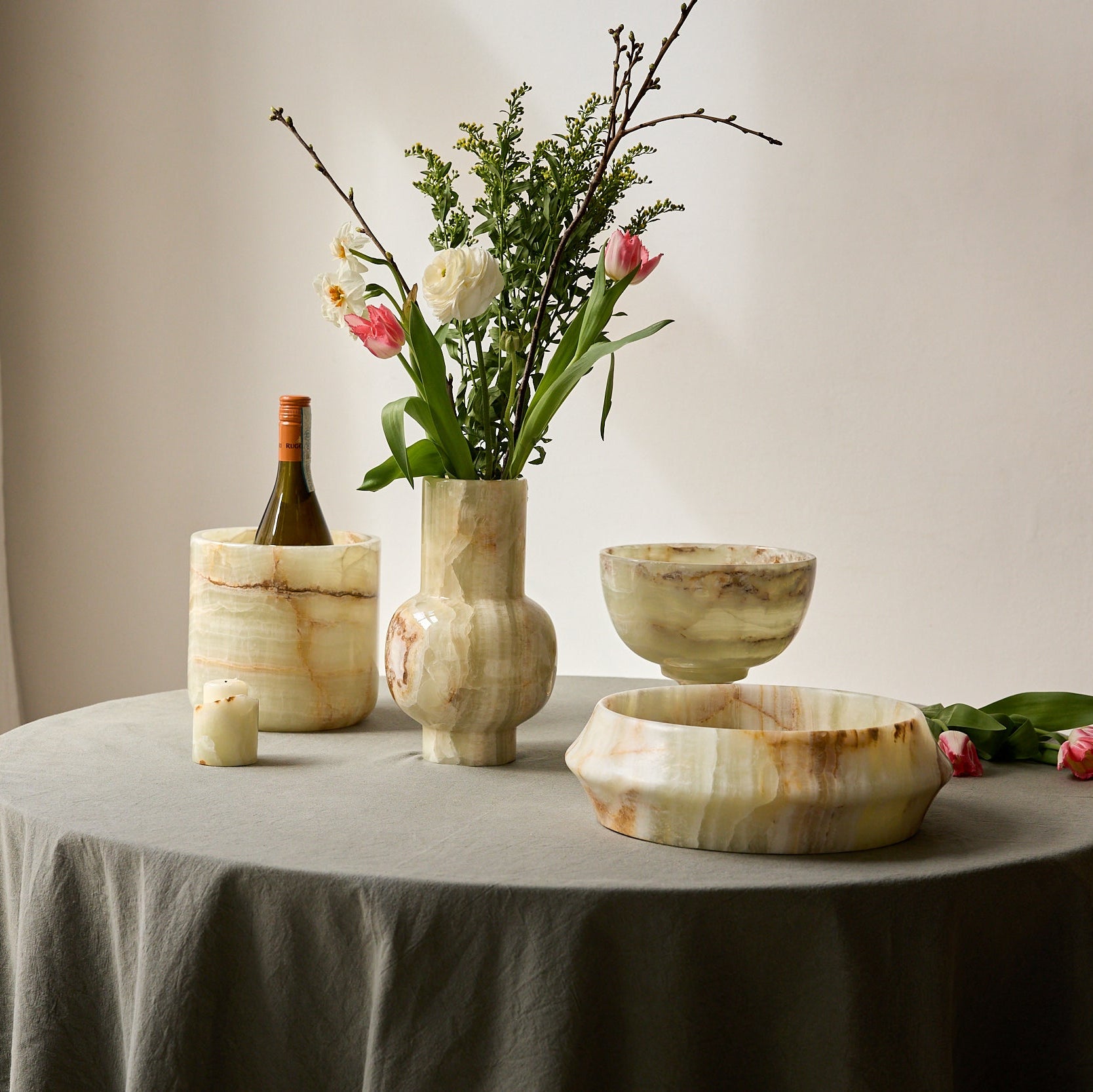
Onyx is the rarest stone in our collection, a banded mineral formed slowly in the cavities of volcanic rock, where silica-rich water deposited layer upon layer over millions of years. Its extraordinary translucence comes from this crystalline structure. It glows when backlit, shifts with its surroundings, and reveals different colours depending on the light. Of all natural stones, onyx is perhaps the most theatrical.
Onyx is not fragile, but it does ask to be handled with care. It is harder than marble, yet its layered structure means it can be more sensitive to sudden impact, sharp knocks, or rapid changes in heat. Its surface is less porous than marble, but staining can still occur if coloured liquids, oils, or harsh substances are left to sit. Strong acids should also be avoided, as they can affect the finish of the stone over time.
None of this makes onyx difficult to live with. It simply means the stone should be treated as the rare natural material it is: gently cleaned, protected from sudden force, and allowed to respond beautifully to light, setting, and use.
"Every piece of onyx is a record of volcanic geology. The banding you see is millions of years of silica-rich water depositing layer upon layer inside rock cavities. No two pieces can ever be the same."

01 — Dry dust regularly Onyx requires less cleaning than more porous stones. A soft, dry microfibre cloth to remove dust is usually all that is needed for weekly maintenance.
02 — Damp wipe sparingly For residue and light marks, a barely damp cloth is sufficient. Wring the cloth thoroughly before contact — standing water should never sit on onyx.
03 — Dry immediately and completely After any damp contact, dry the surface immediately with a clean soft cloth. Never leave moisture of any kind on onyx — mineral residue from water will cloud the surface over time.
Important: Never use spray cleaners, glass cleaners, or all-purpose household products on onyx. Even products labelled as safe for stone often contain surfactants or alcohols that will strip the polish over time.

- Do: Position away from direct sunlight | Prolonged UV exposure can cause certain onyx varieties, particularly warm amber and honey tones, to shift in colour. Indirect or ambient light is ideal.
- Avoid: Heat sources | Keep onyx away from radiators, direct sunlight through glass, and heat-generating candles placed directly on the surface. Thermal shock is the leading cause of onyx cracking.
- Do: Lift, never slide | Always lift onyx pieces to reposition them. The base edges of onyx are a fracture point, sliding puts lateral stress on the most vulnerable part of the object.
- Avoid: Direct candle contact | For our candle holders, always use a candle that fits the opening without touching the stone walls. Heat concentration against the stone wall can cause cracking.
- Avoid: Impact surfaces | Do not place onyx where objects are likely to fall on it, and keep away from edges where it might be knocked. Unlike marble, onyx shatters rather than chips.
Our onyx collection




Marble Care Guide
The nature of marble
Marble is a metamorphic stone, limestone transformed under immense heat and pressure into the material that built the Pantheon, the Taj Mahal, and your Uniiqo piece. It is not fragile. But it is alive to its environment. Understanding that relationship is the beginning of care.
Marble is primarily calcium carbonate, which reacts to acids, including the mild acidity in wine, citrus, vinegar, and even some cleaning sprays. Its surface is also porous at a microscopic level, meaning liquids left to sit will eventually penetrate. The veining you love is where mineral intrusion occurred naturally over time; the same channels are where staining begins if the stone is neglected. None of this makes marble high-maintenance. It makes it responsive.
"Marble does not age, it records.The patina of a well-loved piece tells its story as clearly as any marking in the stone itself."

A little consistency goes further with marble than any single deep-clean. These habits keep your piece looking as considered as the day it arrived.
01 — Wipe daily, dust weekly
A quick wipe with a dry microfibre cloth after use prevents dust and residue from settling into the surface. Once a week, give the piece a more thorough dust, including any recesses or carved details.
02 — Rotate felt pads and coasters periodically
Check the felt pads under objects every few months — they compress and shift over time. Replace any that have worn thin, and reposition decorative objects occasionally so the surface ages evenly.
03 — Address marks the same day
Even small water rings or fingerprints are easiest to remove within the same day. A damp cloth followed by a dry one handles most of these before they have a chance to set.
04 — Give it a monthly once-over
Once a month, clean the full surface with a pH-neutral soap diluted in water, then dry completely. This is also a good moment to check for any new etching, scratches, or areas that need closer attention.

- Do: Use coasters and felt pads | Place coasters under glasses, candles, and vases. Apply felt pads to the bases of objects placed on marble surfaces.
- Avoid: Acidic liquids | Wine, citrus juice, vinegar, coffee, and tomato-based sauces will etch the surface if left to sit. Blot immediately, do not wipe, as wiping spreads the liquid.
- Avoid: Bleach and ammonia | Avoid all-purpose cleaners, bleach, ammonia-based sprays, and abrasive pads. These strip the sealer and permanently dull the polish.
- Do: Blot spills immediately | If something spills, cover with a cloth immediately and press gently. Time is the critical factor, most stains occur because of delay, not the substance itself.
- Avoid: Dragging objects | Never drag objects across marble. Even objects with smooth bases can scratch if grit is present between the object and the stone.
Our marble collection


Travertine Care Guide
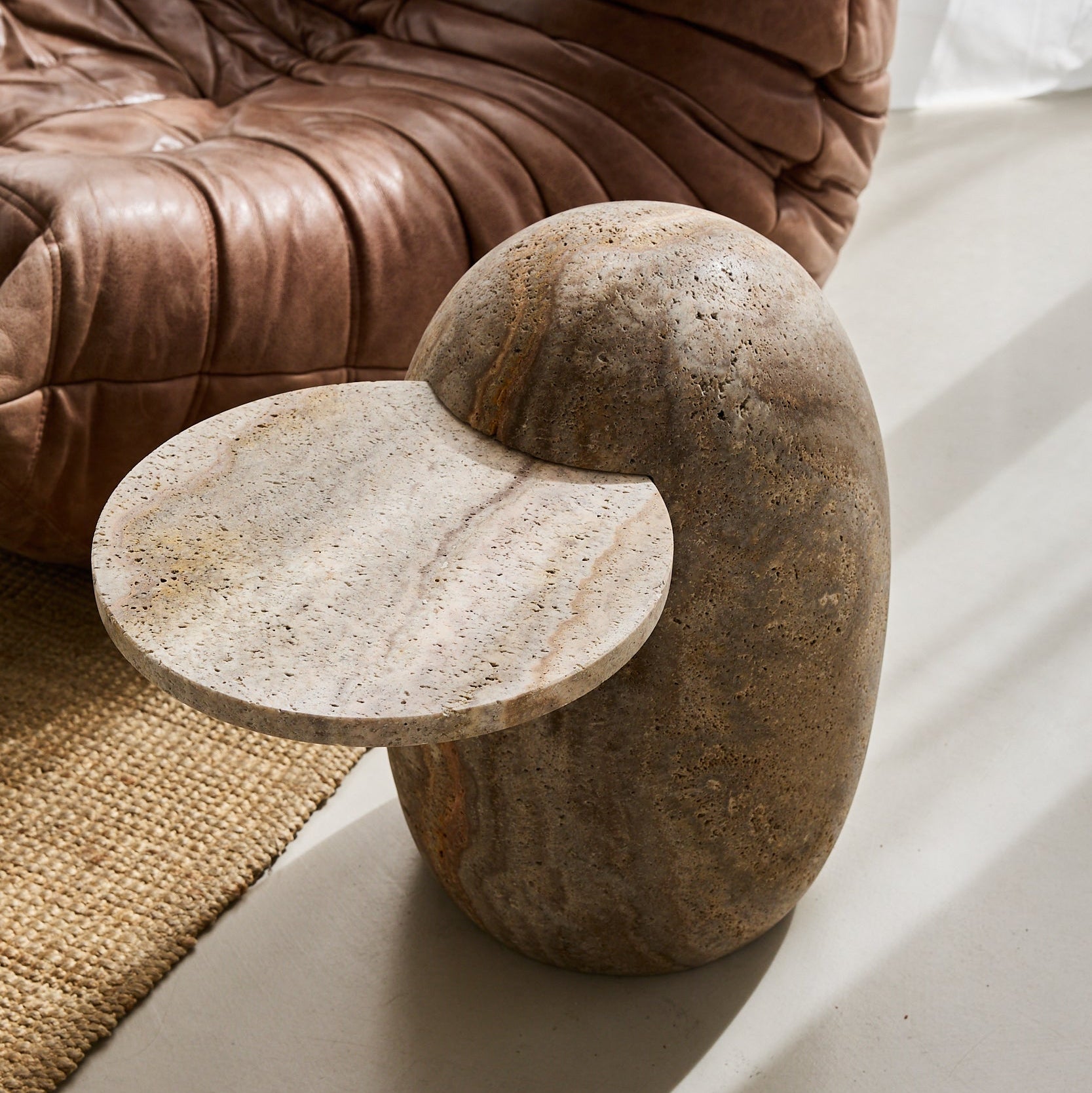
Travertine forms at hot springs and in limestone caves, a sedimentary rock built layer by layer over millennia as carbon dioxide escaped the cooling water, leaving behind the pores that define its surface. Those pores are not imperfections. They are the stone's signature, and understanding how to work with them, not against them, is the heart of travertine care.
Travertine is more porous than marble or onyx, so unsealed it will absorb liquids quickly, and staining can be difficult to reverse once it sets in. Like marble, it is calcium carbonate, which means acids such as wine, juice, coffee, and vinegar will etch the surface on contact, visibly and permanently if not addressed quickly. None of this makes travertine difficult to live with. It simply ages more visibly than other stones, and many of our clients consider the deepening of its warm tones over time to be a feature, not a flaw.
"Travertine was used for the Colosseum, 100,000 cubic metres of it. What survives is not despite its porosity, but in part because of it. The stone breathes. It responds to its environment. It outlasts almost everything made to replace it."

01 — Dust with a soft dry cloth | Travertine's textured surface can trap dust in its natural pores. Use a soft, dry cloth or a natural fibre brush to remove dust from the surface and any recesses.
02 — Clean with pH-neutral stone cleaner | For more thorough cleaning, use a dedicated stone cleaner diluted in water. Apply with a soft cloth, working gently. A pH-neutral dish soap in warm water is a good household alternative.
03 — Rinse and dry completely | After cleaning, wipe with a clean damp cloth to remove any soap residue, then dry thoroughly. Standing water in the pores of travertine will leave mineral deposits over time.
04 — Blot spills without delay | Given travertine's porosity, speed is critical when something spills. Cover immediately with a clean cloth and press, do not wipe, which spreads the liquid into more pores. Follow with damp cleaning and dry thoroughly.

- Do: Protect high-use travertine surfaces | Travertine is naturally porous, so larger or frequently used surfaces, such as tables, can benefit from sealing every six months. For decorative objects, sealing is usually not necessary with normal indoor use. If sealing is preferred, use an impregnating penetrating sealer, not a topical coating sealer.
- Avoid: Vinegar and lemon-based cleaners | Many natural cleaning products use citric acid or vinegar, both of which will etch travertine immediately. Always check product contents before using on stone.
- Do: Use protective bases | Felt pads, coasters, and protective mats beneath objects are essential, especially for metal objects, which can leave rust marks on unsealed travertine.
- Avoid: Abrasive cleaning pads | Never use wire wool, scouring pads, or abrasive powders. Travertine's surface can be scratched, and the natural texture of its pores is irreplaceable once damaged.
- Do: Embrace the texture | The open pores in travertine are part of its natural character. Attempting to fill them with household products often causes more harm than leaving them as they are.
- Avoid: Prolonged water exposure | Travertine pieces should not sit in water or be used as planters without a waterproof liner. Prolonged moisture leads to mineral staining and eventual surface degradation.
Our travertine collection




Common Questions for Onyx Pieces
How do I keep my onyx piece looking polished?
How do I keep my onyx piece looking polished?
Onyx is naturally luminous, and a little gentle care helps preserve its depth and shine. Wipe the surface with a soft, damp cloth, dry it immediately, and avoid abrasive pads, acidic products, or leaving water to sit on the stone. For decorative use, this is usually enough to keep the piece looking beautiful over time.
There's a ring mark from a glass on my onyx surface. Can it be removed?
There's a ring mark from a glass on my onyx surface. Can it be removed?
If the ring is from water evaporation, clean with a damp cloth and buff dry, mineral deposits often lift with a little effort. If the mark has a slightly rough texture, it may be etching from a mildly acidic drink. Light etching can sometimes be improved with a fine polishing compound; deep etching typically requires professional attention.
I've noticed the amber veining looks different in different lights. Is something wrong?
I've noticed the amber veining looks different in different lights. Is something wrong?
Nothing is wrong, this is one of onyx's defining qualities. The stone is translucent, and its colour shifts dramatically with the angle, temperature, and intensity of the light source. This is the material behaving as it should.
My onyx bowl has a hairline crack. Is this reparable?
My onyx bowl has a hairline crack. Is this reparable?
Hairline cracks can sometimes be stabilised and made less visible by a professional stone conservator, but cannot be made invisible. We recommend contacting us directly at hello@uniiqostudio.com — we can advise based on the specific piece and severity of the crack.
Common Questions for Marble Pieces
My marble has a dull, rough patch where something acidic sat. Can it be repaired?
My marble has a dull, rough patch where something acidic sat. Can it be repaired?
This is called etching — a chemical reaction that removes the polished surface layer. Light etching can be improved with a marble polishing powder (tin oxide) applied with a soft cloth. For deep etching, professional re-polishing by a stone restoration specialist is recommended.
There's a stain that won't come off with soap and water. What now?
There's a stain that won't come off with soap and water. What now?
Try a poultice: mix baking soda with water into a thick paste, apply over the stain, cover with cling film, and leave for 24–48 hours. As the paste dries, it draws the stain out of the stone. For oil-based stains, use a poultice mixed with acetone instead of water.
My marble piece has developed a natural patina over time. Should I try to restore it?
My marble piece has developed a natural patina over time. Should I try to restore it?
That depends entirely on your preference. Many collectors and designers value the lived-in quality of aged marble, it is the authentic mark of a material engaging with the world. If you prefer the original polish, a stone professional can restore most surfaces to near-original condition.
Is it safe to use my marble bowl for food?
Is it safe to use my marble bowl for food?
Our marble pieces are decorative objects and are not intended for direct food contact. The sealer used in maintenance is not food-grade. For serving, we recommend using them as presentation vessels with a separate dish or lining inside.
Common Questions for Travertine Pieces
My travertine tray has a dark stain that won't clean off. What should I try?
My travertine tray has a dark stain that won't clean off. What should I try?
Dark stains in travertine are usually oil-based. Make a poultice from baking soda and acetone, apply it thickly over the stain, cover with cling film, and leave for 24–48 hours. As it dries, it draws the oil out of the pores. Repeat if necessary. For water-based stains, use baking soda and water instead.
Will the surface change over time?
Will the surface change over time?
Travertine is a natural stone, so it may develop subtle signs of use over time. This is part of its character. With gentle cleaning and care, your piece will remain beautiful for years.
The natural pores seem to be collecting dust and darkening. Should I fill them?
The natural pores seem to be collecting dust and darkening. Should I fill them?
The pores can be cleaned with a soft brush and stone cleaner, work in small circular motions to lift accumulated residue. Filling them with a home product is not recommended, as household fillers often discolour or contract over time. A stone specialist can fill them professionally using colour-matched stone filler if desired.
My travertine piece has an orange rust mark near where a metal object sat. How do I remove it?
My travertine piece has an orange rust mark near where a metal object sat. How do I remove it?
This is iron oxidation, rust transferred from a metal base into the porous travertine. It requires a specialist rust-removing poultice (iron-out products are available from stone care suppliers). Avoid placing iron or steel objects directly on unsealed travertine in future.